
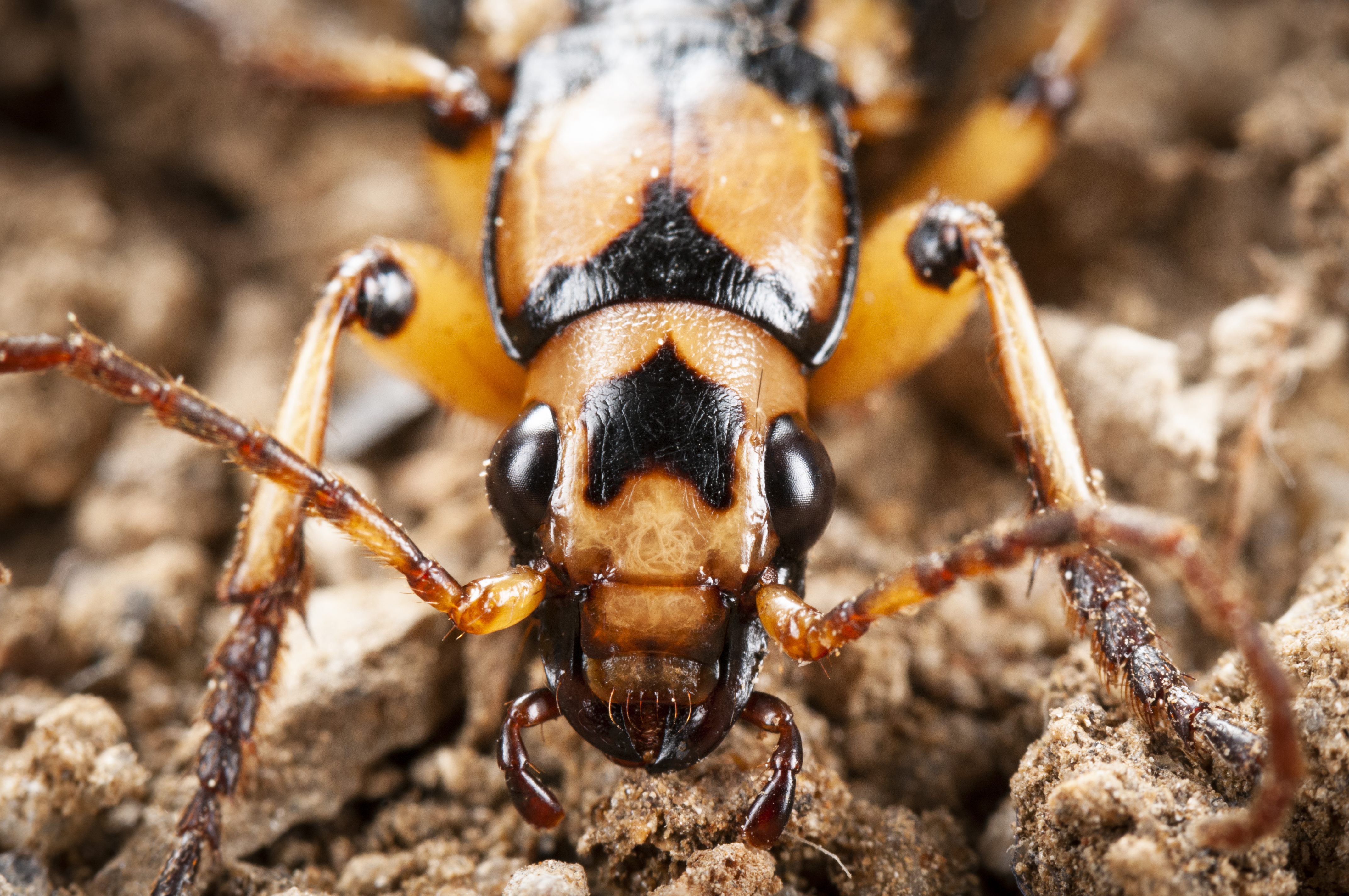
Few animals produce chemical weapons inside their bodies. Bombardier beetles are one of them. When a predator threatens them, they set off a fast chemical reaction inside two defensive glands. They spray a hot liquid containing benzoquinones at the attacker.
Bombardier beetles belong to the Carabidae family. The name applies to species in several groups, particularly the subfamily Brachininae. There are more than 500 species, and they live on every continent except Antarctica. Their defensive systems differ between species, though. Some fire a hot, aimed stream. Others release a cooler mist.
The spray consists of benzoquinones, which are irritating chemicals. Other insects also use them for protection. What is unusual is that bombardier beetles keep the enzymes apart from the stored chemicals and bring them together only when they need the spray.
Chemistry on Demand
Each defensive gland has several parts. The gland system produces the precursor chemicals, and the reservoir chamber stores them. In the reaction chamber, the chemicals react. And the outlet lets the mixture exit through the tip of the abdomen.
In the Brachinus species scientists study most often, the reservoir holds a liquid mixture of hydrogen peroxide and hydroquinones. Earlier chemical analyses recorded concentrations of about 25 percent hydrogen peroxide and 10 percent hydroquinones, but the amounts and chemical makeup differ among species. The reservoir may also contain other compounds that help dissolve and carry the active chemicals.
The stored substances stay stable because the enzymes are kept apart from the reactants. When a predator attacks, muscles around the reservoir contract and push the mixture through a tube into the reaction chamber.
The reaction chamber is stiff and thick-walled. Its lining protects nearby tissue from the heat and the corrosive chemicals.
Inside the chamber, catalase and peroxidase enzymes speed up the reaction. Hydrogen peroxide breaks down into oxygen and water, while hydroquinones turn into irritating benzoquinones. The reaction raises the temperature and builds pressure, which pushes the products out through the opening in the abdomen.
An earlier study estimated the reaction's heat at 48.5 kilocalories per mole of hydroquinone. That number comes from older data on one system and may not apply to every species.
More recently, a 2025 study of Brachinus crepitans added specific molecular detail. Using transcriptomic and proteomic analyses, the researchers identified catalases, peroxidases and enzymes in the glands that produce hydroquinone. They also found evidence that the beetles use glucose to make hydrogen peroxide and compounds related to hydroquinone. This describes Brachinus crepitans and may not apply to every bombardier beetle.
Not Always Boiling
The spray can be very hot, but the temperature varies among species. Some Brachinus species have been recorded at nearly 100°C, while others release a much cooler spray. Those readings are hard to take, and the highest ones trace back to a single 1969 study.
Elsewhere, studies report about 63–65°C in some Crepidogaster or similar beetles, 55°C in Metrius contractus and 34–47°C in Mystropomus regularis.
So not every bombardier beetle fires boiling liquid. Reported temperatures run from about 34°C to nearly 100°C, depending on the species and the structure of its glands.
More than one process creates the pressure. The reaction releases oxygen gas, and the heat can turn some water into vapor. Mathematical models show that the oxygen alone can create substantial pressure, even when the chamber stays below 100°C.
Some aimed sprays travel up to about 30 centimeters. Speeds vary a lot. For Stenaptinus insignis, the average is about 12 meters per second, with a range of 3.25 to 19.5.
The exit is at the tip of the abdomen, and many bombardier beetles can point the spray at a predator. Some species move the abdomen or the exit enough to hit attackers coming from different angles.
This helps against ants and other predators that strike from the side or the rear. Aiming ability varies among species.
The spray is highly effective against many vertebrate and invertebrate predators, but bombardier beetles are not invulnerable. A few specialized predators have developed ways to eat them anyway.
Bursts, Not Streams
One unusual feature is that some species do not eject an even stream. In a 1990 study, scientists observed Stenaptinus insignis and found that the liquid came out in fast bursts.
The bursts came about 500 times per second, with a reported range of 400 to 800 hertz. Each discharge lasts roughly 3 to 24 milliseconds and contains about two to twelve pulses.
The scientists compared the spray to the pulse-jet engine of the German V-1 flying bomb. The comparison is about how the fluid flows, not about matching internal parts.
The mechanism differs among species. Some release an even stream, while others produce mist or foam. In 2013, a mathematical model showed that chamber size, inlet size, reaction speed and heat loss can produce different discharge patterns, including continuous cycles, pulsed cycles and steady flow.
For years, scientists could only watch the spray leave the beetle. In 2015, researchers from MIT, the University of Arizona and Brookhaven National Laboratory used high-speed X-ray imaging at Argonne National Laboratory to look inside.
They filmed living beetles during the discharge at 2,000 frames per second. The footage showed the internal mechanics behind the fast bursts.
A flexible membrane and a nearby valve control the passage between the reservoir and the reaction chamber. Muscles first push the stored liquids into the reaction chamber, and the reaction then makes the pressure rise quickly. That pressure pushes against the membrane and shuts the inlet valve, which stops more liquid from entering. The products exit through the opening in the abdomen. As the pressure drops, the membrane returns to its original shape and the inlet opens again, so the next burst can start.
It is a pressure-driven feedback system. The valve needs no separate muscle contraction for each pulse, though muscles still start the flow of chemicals.
The chamber walls are stiff and strong, which helps them endure repeated changes in pressure and temperature. The pauses between pulses may also let the walls cool a little. This is a possible benefit, not a proven function in every species.
The Open Questions
The 2025 study combined transcriptomic analysis, which measures gene activity, with proteomic analysis, which identifies the proteins present.
The study's findings suggest that hydroquinones may be produced through pathways involving phenylalanine, tyrosine and other metabolites. The beetle may store hydroquinones in more stable forms before use. Glucose metabolism contributes to hydrogen peroxide production. Catalases and peroxidases are abundant in the gland system and take part in the reaction. The beetle also has genes and proteins that may help it recharge its glands after firing.
The research shows how the glands are supplied and maintained, but several conclusions are still provisional. More experiments are needed to confirm the functions of some enzymes and to find out whether the same processes exist in other bombardier beetles.
A 2013 mathematical model showed that one basic system can produce the different spray patterns seen in bombardier beetles. This suggests the different versions of the defense may have developed from one ancestor.
It does not prove the explosive defense evolved only once. Bombardier beetles belong to several taxonomic groups, and the evolutionary relationships between them are still debated. A shared mechanism is possible, but the evolutionary history is not settled.
Engineers Are Watching
Engineers are interested in the beetle's defense. It combines chemical energy, pressure control, rapid pulses and physical protection in a small body.
Researchers suggest the design could inspire blast-protection systems, pressure regulators, pulsed sprays, propulsion and small-scale fluid control. Related biomimetic models also discuss fuel injection, nebulizers, inhalers and fire-extinguishing sprays.
These are proposed uses, not proof that any device copies the beetle's whole mechanism.