
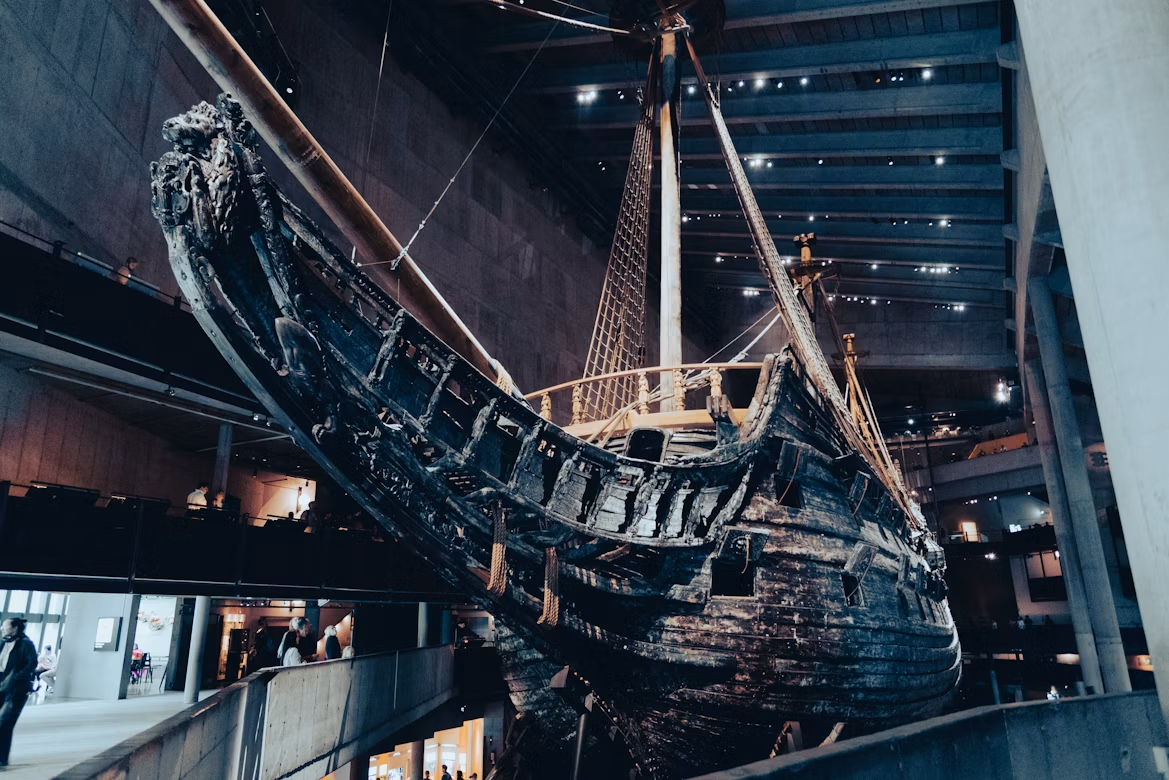
A Warship Fit for a King
During the beginning of the sixteen hundreds, Sweden expanded into a regional power in Northern Europe under King Gustav II Adolf. The nation also engaged in a persistent military conflict against the Polish Lithuanian Commonwealth. To improve Swedish control over the Baltic Sea, the king commanded shipbuilders at the Stockholm naval facility to build a vessel that was large and carried many cannons.
The ship received the name Vasa to represent the Swedish royal family line. It took shape under the Dutch master shipwright Henrik Hybertsson, who had extensive knowledge from building previous vessels for the Swedish government. After Hybertsson became ill and died while construction continued, his assistant Hein Jakobsson took over the remaining work.
Vasa was not only an instrument for naval combat, it also served as a physical demonstration of the authority held by the Swedish monarch. There are more than 700 carved figures and decorative elements on the ship, like lions, leaders of the Roman Empire, characters from the Bible, figures from ancient myths and emblems of the Vasa family. Many of those carvings are covered in vivid pigments, and gold leaf coats certain sections of the decorative work. The ship was meant to affect the emotions of Swedish citizens, but also the nation's military rivals.
The shipbuilders designed the Vasa to transport many large weapons. The ship carried 64 cannon when it began its journey, including heavy guns that fired 24-pound balls. The final structure included two levels for weapons that were inside the ship; this arrangement provided the vessel with high destructive force but it also put many tons of mass far above the surface of the water.
The specific facts about the first plans are not fully known and it is more accurate to avoid claiming that the builders intended the ship for only 36 guns. It is certain that the dimensions changed while the laborers built the vessel, and the finished ship carried 64 guns on two separate levels.
A Ship Built to Fall Over
The main difficulty for the vessel was its balance in the water. The parts of the Vasa above the water were very high and heavy compared to the small part of the hull that stayed under the water, so the ship's centre of gravity was too high. As the ship tilted to one side, it lacked the physical force to pull itself back to a vertical position.
But the cause of the failure was not only the addition of one extra level. The lack of balance resulted from the combined effect of the hull's width, the tall structure, the heavy guns, the ballast and how the weight was distributed. Seventeenth century builders lacked the complex equations that modern engineers use to determine if a vessel is safe before they build it, so they relied on their past work and traditional habits.
The researchers found archaeological evidence that builders used both Swedish and Amsterdam measurement systems in the shipyard. The Swedish foot and the Amsterdam foot differ in length, but the claim that this unit difference made one side of the vessel heavier and caused the sinking is not certain. The most supported explanation is that the ship is unstable in its structure and carries too much weight above the waterline.
The danger was visible before the vessel left Stockholm: Captain Söfring Hansson informed Vice Admiral Klas Fleming that the ship was unstable. Fleming ordered a practical test where thirty sailors ran from one side of the upper deck to the other.
As the sailors crossed the deck multiple times, the ship rolled with enough force that Fleming stopped the test. He feared the ship might roll over while it was at the quay. In the account from the investigation, Fleming stated that he wished the king was present to see the test.
On account of the king's orders, the builders did not change the design or delay the departure. There was pressure for the ship to begin the voyage and the launch continued. Political and practical demands caused the ship to sail even though officers knew about the instability. To say that no official dared to challenge the king is an exaggeration.
Twenty Minutes to the Bottom
The ship Vasa departed from Stockholm on Sunday, 10 August 1628, as many residents of the city watched. The crew planned to sail the vessel to the fortress at Vaxholm so that family members and invited visitors could disembark, and she was then to travel to the naval base located at Älvsnabben. It is possible that the Swedish navy intended to use the ship to strengthen the blockade of Gdańsk or to assist the squadron that guarded Stralsund.
By using anchors the sailors moved the ship through the harbour until they raised four sails and fired a ceremonial salute. There was very little wind at first, and the vessel drifted with the current below the cliffs of Södermalm. A gust then filled the sails and tilted the ship to port. The vessel slowly righted itself, but a stronger gust at a more exposed part of the harbour pushed the ship over a second time. Water entered the interior through the open gunports of the lower gun deck. The captain gave an order that the sailors should release the sails and close the gunports but the event happened too quickly.
The ship settled on the seabed at a depth of 32 metres and the remains of the vessel stayed approximately 120 metres from the land. It moved for a distance of less than one kilometre, which historians estimate to be between 1,100 and 1,300 metres; this refers to how far the ship travelled, not how far offshore it sank. In various historical records, the specific times of the events are different, but the ship had been under way only a short time, and the sinking itself took just minutes.
The death toll reached roughly thirty individuals but the majority of those aboard remained alive. Many of the deceased were trapped inside the lower compartments of the vessel. The survivors included Captain Söfring Hansson, who was almost dragged beneath the waves by the sinking hull. The wreck remained partly visible, as the masts extended above the water.
He faced arrest and answered questions immediately following the sinking. The Council of State initiated a formal examination on the next morning; this process involved interviews with the captain, the sailors, the builders and government administrators.
But the authorities did not convict any individual: the legal process failed to identify a specific person as the cause of the event, even though the evidence indicated that observers doubted the balance of the ship before it sailed. The builders claimed they adhered to the plans the monarch authorized, while the captain and the crew members spoke in support of their own actions.
It is inaccurate to claim that Gustav II Adolf measured every part of the vessel himself. He gave permission for the task and demanded that workers finish the ship quickly but the engineers and the shipyard staff managed the technical drawings and the assembly.
Three Centuries in the Dark
The wreck became a valuable target because the bronze cannon stayed inside the hull. Using primitive diving bells between 1663 and 1665, divers retrieved most of the valuable guns. After this, the wreck was largely forgotten.
The ship remained intact for more than three centuries because of the environment in Stockholm harbour and the Baltic Sea. The water in the Baltic Sea contains little salt, which restricts the activity of shipworms, those marine organisms that consume wooden wrecks in many bodies of saltwater. The water is cold and dark, and the sediment also helped preserve the ship.
The condition of the vessel is not only a result of industrial waste or a lack of microbes that eat wood; those factors may have changed the underwater environment, but historians and conservators usually point instead to the low salt levels and the absence of shipworms.
In the 1950s Anders Franzén, who was a Swedish naval engineer as well as maritime historian, started to look for the wreck. He thought that the ship still existed because the Baltic environment causes less damage to wooden ships than the open ocean.
In 1956 he found the wreck when he used a coring device that he built himself. The device pulled pieces of oak from the floor of the sea and proved that he located the ship. The Swedish navy, government agencies and private organizations subsequently provided resources for a salvage operation.
Raising a Ghost Ship
In 1957 divers worked in dangerous and dark spaces beneath the wreck. They dug six tunnels under the hull and pulled steel cables through the openings. The cables were attached to pontoons that float on the surface.
The salvage crew filled the pontoons with water and subsequently used pumps to remove the liquid in stages. As the pontoons became more buoyant, the equipment lifted the ship in small increments. The team conducted the operation through a series of specific, monitored movements because a sudden upward force might have broken the weak hull.
In 1959 the divers had freed the Vasa from the silt and moved the vessel into shallower water. Further work was needed to prepare the ship for its final recovery. On 24 April 1961 at 9:03 a.m., the Vasa broke the surface of the water while international television cameras recorded the event. The ship was located on the seabed for approximately 333 years.
The phrase "exactly 333 years" is not numerically exact because the ship sank in August 1628 and resurfaced in April 1961. "After approximately 333 years underwater" is the precise wording.
The recovery of the Vasa was the start of the preservation difficulties. Waterlogged oak wood often shrinks, cracks and deforms when the moisture evaporates. After the crew raised the ship, conservators kept the surfaces wet and began to apply polyethylene glycol, which specialists call PEG, to the timber.
The sprinkler system sprayed the ship with a PEG solution without interruption for many years. The primary treatment occurred from 1962-1979. PEG enters the saturated wood but also helps to decrease the contraction and fracturing that happens if the wood loses moisture without this chemical. It is more accurate to state that PEG stabilized the waterlogged timber than to claim the substance moved into the wood cells to occupy the space of every water molecule.
The Fight Isn't Over
The Vasa is under continuous observation by staff, since sulfur compounds entered the wood during the centuries the ship stayed underwater, and those compounds can react with oxygen to create sulfuric acid. It is possible for this acid to harm the timber and metal parts. Chemical processes also make the oak less strong and cause the hull to change shape in specific sections. According to the Vasa Museum, the wood is significantly less durable in some areas. This weakness makes better structural reinforcement necessary.
The ship is currently in need of a new support system; to address this, workers started to install a replacement structure in 2024. The goal is to finish this task by 2028, the four hundredth anniversary of the sinking. The project includes structures on the outside and inside of the hull, and those are intended to stop the ship from moving and to stop cracks from appearing. The system is meant to maintain the ship's current shape.
The statement that the ship is "sinking again" describes how the wood slowly changes shape and requires more help to stay upright. It is not accurate to say the vessel is moving downward into the museum floor.
The Vasa is on display at the Vasa Museum on Djurgården in Stockholm. As the museum states, the ship is the most intact example of a vessel from the 1600s. The building is among the most frequented locations in Scandinavia, and by searching the ship and the nearby seabed, researchers found more than 40,000 objects; those items show how workers built ships, how sailors fought in wars and how inhabitants lived in Sweden during the early seventeenth century.
The museum attracts over one million tourists every year and reached a peak of 1.5 million tourists during 2019. "Around 1.5 million visitors a year" should not be presented as a fixed annual figure. A more accurate description is that the museum receives more than one million guests annually, though attendance surpassed 1.5 million in 2019.
A Lesson in Hubris
The history of the ship is frequently an example of errors in planning and engineering. In management books, the phrase "Vasa syndrome" describes a large project where the objectives are greater than the capacity of a group to control complex details and risks. The authors Eric H. Kessler, Paul E. Bierly III and Shanthi Gopalakrishnan discussed this phrase in a 2001 article titled "Vasa Syndrome: Insights from a 17th-Century New-Product Disaster".
The name is a recent idea from management theory instead of a name from the seventeenth century. It is a concept that business researchers created and it is not a definition that every historian who studies the ship accepts.
The loss of the Vasa resulted from multiple errors occurring at the same time. The shipwrights placed a large amount of weight high above the surface of the water, and the ship did not have enough heavy material in the hold to balance its dimensions and many cannons. The admiral did not order a redesign after the vessel failed a stability test. On the day of the voyage, the ship sailed with the lower gunports open. The king wanted to show the military strength of Sweden and this desire was more important than careful engineering. Responsibility for the event belongs to Gustav II Adolf, the naval officers, the builders and the sailors.
Gustav II Adolf ordered the construction of the Vasa to show that Sweden was wealthy and militarily strong, but the first journey of the ship proved that a project is dangerous when a schedule and the desire for status are more important than physical evidence. The important fact is not that a single man caused the failure. It is that known dangers cause deaths when the leaders do not fix the problems before a project begins.