
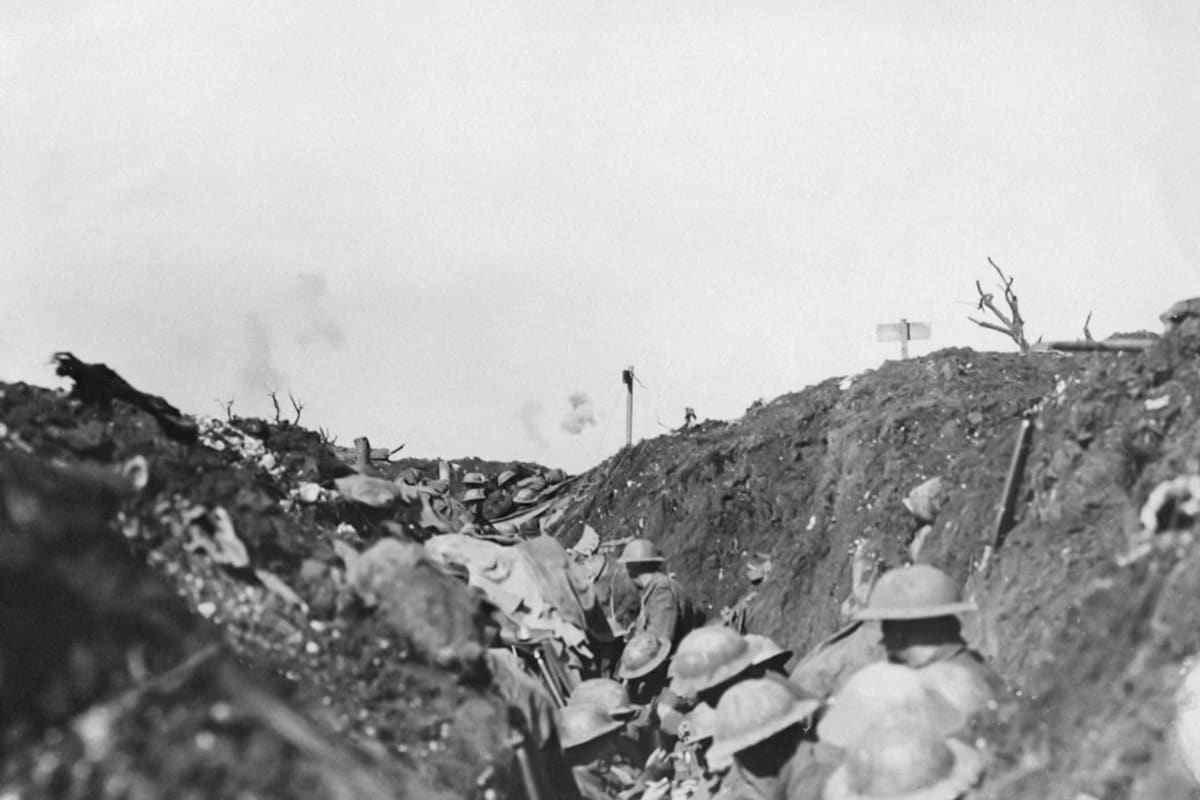
The governments of European countries began military operations during the summer months of 1914. There was a common expectation among citizens and leaders that the military engagement would conclude quickly. The belief was that infantrymen would return to their households before the December holiday - but after five months had passed, this confidence no longer existed. The French & British armies stopped the German military movement during the First Battle of the Marne. The subsequent "Race to the Sea" resulted in a situation where neither side could gain an advantage. By December, soldiers had dug a connected network of trenches - roughly 400 to 475 miles long - stretching from the Swiss border to the North Sea. The technical nature of modern trench combat was now apparent, and it had caused significant destruction.
The living environments were hazardous and unsanitary - soldiers occupied narrow excavations that were filled with water. They existed among wet soil, rodents and the odor of decomposing bodies. Confidence among the troops was low because the combat was violent, and many soldiers had died or suffered injuries. As the holiday of Christmas arrived, an unusual event occurred along the Western Front. It was a ceasefire that happened without official orders or political negotiations - this event originated because the men who occupied the trenches recognized their shared humanity.
The Truce Nobody Officially Allowed
To provide a formal pause in fighting, officials had previously discussed a proposal. Pope Benedict XV became the leader of the Catholic Church one month after the start of the war. On 7 December 1914, he requested "that the guns may fall silent at least upon the night the angels sang". Both the Allied and Central powers declined this request.
The combatants in the trenches intended to act differently - the German Emperor William II provided small evergreen trees to the military units to increase their confidence, which influenced the environment. On December 24, German troops positioned those trees on the edges of the defensive earthworks and illuminated them with candles. In the area of Chapelle d'Armentières, the British infantry viewed the visual effect and stated it was like "the footlights of a theatre"
Then came the music - German soldiers sang religious songs like Stille Nacht ("Silent Night"), and the sound moved across the icy ground between the opposing lines. The British infantry perceived the singing with intense interest. As the music stopped, some groups clapped while others fired flares to show their approval. The British units answered - singing carols like "The First Noel" and "O Come, All Ye Faithful" By the time the British sang the second carol, the Germans participated - singing the Latin text, Adeste Fideles. Shouts of "Merry Christmas" traveled between the two sides. To manage the situation, some British lieutenants and captains told the riflemen to remain still unless the enemy attacked first and they did this without permission from senior commanders - this tactic is identified as "live and let live"
Guns Down, Christmas Morning
The transition from conflict to peace occurred by the morning of December 25. German soldiers climbed out of their defensive ditches and waved their arms to show they carried no weapons. British infantry units approached the German soldiers shortly afterward. In many specific locations, the soldiers stopped firing their weapons. There were approximately 100,000 British & German combatants who participated in those unofficial pauses in fighting across various segments of the Western Front.
On the ground between the opposing trenches, the soldiers who previously fought each other grasped hands. They gave each other tobacco products and divided the small amounts of extra food and supplies they owned, including chocolate, tinned meat, alcohol, and souvenirs like buttons and hats. A written account from the British 5th Division states that a German officer walked forward carrying a box of cigars. The officer was met by many individuals from both armies who spoke together and took tobacco from one another.
The mental image of a soccer game is a persistent part of this historical event - but researchers state that the events were less structured than popular stories describe. No Man's Land is a terrain filled with deep holes from explosions and is covered in metal wire and dead bodies. There is no evidence of one large game that many observers watched. Small groups of men likely kicked objects around in an unplanned way. Some used actual balls, while others kicked a bully-beef tin. Lieutenant Kurt Zehmisch of the 134th Saxon Infantry Regiment recorded in his journal that the British men carried a soccer ball out of their defensive positions. He observed that a lively game began quickly after the ball appeared.
The participants viewed the event as unusual and surprising - in an account from Lieutenant Johannes Niemann, he claimed the Germans beat the British 3-2, with goals marked by caps. If the event is a factual recollection or a legend, the sport represents a common cultural interest that exists despite the war.
The cessation of hostilities included serious activities as well as social interactions. Some of its most solemn moments involved joint burial services. Both armies utilized the delay to recover deceased soldiers from the empty terrain between the trenches so they could inter the bodies with respect.
Captain Robert Patrick Miles of the King's Shropshire Light Infantry served with the Royal Irish Rifles. He detailed the environment in a correspondence composed between December 25 & December 28, 1914
"On Friday, which is Christmas Day, we are experiencing a highly unconventional holiday. A truce is present between us and the opposing soldiers which no one organized or officially permitted but everyone understands and follows it strictly. It is strange because the agreement appears to occur only in this section of the front. To our right and left directions, we can hear the other combatants shooting at one another with their usual frequency.
The situation began yesterday evening during a very cold night characterized by frozen dew. As soon as the sun set, the German troops began calling out 'Merry Christmas, Englishmen' to our positions.
The British soldiers shouted in response to the German soldiers. Large groups of men from both armies exited the trenches without weapons - those soldiers gathered in the area between the combat zones where bullets frequently hit the ground. They exchanged cigarettes and shared stories in a friendly manner. No one used a firearm during the night.
Miles died in action on 30 December 1914, two days after finishing this letter.
It's crucial to recognize that the Christmas Truce did not occur everywhere. Military leaders did not give official permission for those events. Combat remained continuous in many geographic areas. The cessation of violence was most effective where British units fought against Saxon units. The soldiers in the locations viewed the Saxon men as friendly and reliable.
French & Belgian troops felt much less desire to cooperate - german military forces had seized large parts of France during 1914. The hatred toward the occupying soldiers was too strong for the French & Belgian men to ignore during a religious holiday. There was no similar broad agreement to stop fighting on the Eastern Front. Russia followed the Julian calendar during that period. The Russian soldiers did not celebrate Christmas until the beginning of January.
The Brass Wanted This Forgotten
But some individuals who observed the truce expressed disapproval. Adolf Hitler worked as a corporal and message carrier for the 16th Bavarian Reserve Infantry at that time. He spoke harshly about the soldiers who interacted with the opposing side. He stated
"Such a thing should not happen in wartime. Have you no German sense of honour?"
The senior military leaders considered the ceasefire a serious threat to discipline. In early December, British Lieutenant General Sir Horace Smith Dorrien, who commanded II Corps, told officers that soldiers near the opposing forces could develop a "live and let live" perspective. He believed the soldiers would enter a state of "a military lethargy from which it is difficult to arouse them" and issued specific instructions that "friendly intercourse with the enemy, unofficial armistices … and the exchange of tobacco and other comforts … are absolutely prohibited".
The headquarters responded with quick and harsh actions when they received accounts of the friendly interactions between the opposing armies. Field Marshal Sir John French, who led the British Expeditionary Force, produced orders to stop future instances plus promised that he would penalize the soldiers. On the German side, a command from 29 December 1914 prohibited friendly contact. It warned that such actions "every approach to the enemy will be punished as treason" and were the same as high treason, which allows the state to execute the offender.
The British & German commanders required the interaction to end and threatened the soldiers with a court martial - but many officers who stayed in the trenches did not follow those instructions. There are no legal records of a court martial for the events of 1914. It's probable that the high-ranking officers understood the punishments would cause a severe loss of morale among the soldiers.
The military leaders acted with caution during the subsequent years. In 1915 the officers stopped soldiers who tried to restart the peace agreements. The commanders ordered the heavy guns to fire at the battle lines - those explosions made it impossible to hear the carols. There were no broad halts in the fighting on the Western Front until the signing of the peace treaty in November 1918.
On most parts of the line, the soldiers stopped fighting for forty eight hours. In a few small areas, the peace lasted until the start of January. Then the soldiers began to kill one another again. A British officer wrote that he displayed a cloth with the words "Merry Christmas" on the night of the holiday. The German leader replied - showing a sheet with the text "Thank you". The British officer used his rifle to shoot twice into the sky and "the war was on again".
But the soldiers remembered what happened - the government had not yet started to read and block the private mail of the troops. As a result the soldiers sent many written descriptions of the events to the news organizations. The readers reacted with intense interest to those reports. After the conflict ended, the event became a symbol of something precious and fragile. It showed that the soldiers in the opposite trenches were not demons. The men acknowledged that their enemies felt the low temperatures, the terror of death and the desire to return to their families.
The Christmas Truce of 1914 is a significant event within the history of the First World War. The soldiers in the trenches initiated this cessation of fighting themselves rather than through formal discussions between government leaders. It was an unofficial period where the soldiers acted with mutual respect despite the military conflict. Lieutenant Zehmisch stated that it was a moment when "Christmas, that celebration of love, managed to bring together mortal enemies as friends, for a time".
Nothing could erase what those soldiers had shared in the cold terrain between the opposing trenches. The event remains a testament to the human spirit, even in the middle of war.